_kdi real logo.svg)







For years, the story of Nigeria’s democracy has largely been told from outside its borders. International democracy rankings, governance scorecards, and foreign policy assessments have shaped global perceptions of whether Africa’s largest democracy is progressing or declining.
But democracy is not best understood through distant assessments or international scorecards. Its true measure lies in the everyday experiences of citizens.
It is measured in terms of whether institutions can be trusted, whether public officials are accountable, whether young people see a future within the political system, whether citizens can speak freely without fear, and whether participation produces outcomes people can feel.
This is why the State of Democracy in Nigeria 2025 Report by Kimpact Development Initiative (KDI) matters far beyond statistics and rankings. It is one of the first major attempts to measure Nigeria’s democratic performance from within, state by state, institution by institution.
Using a composite methodology that combined the official records with citizens and stakeholders' perception, the Democracy Performance Index assessed all 36 states across key dimensions; electoral participation, political inclusion, democratic institutional effectiveness, and civil liberties/civic space. States were scored on a 0-100 scale and classified into four performance thresholds: High, Moderate, Low, Weak Democratic performance.
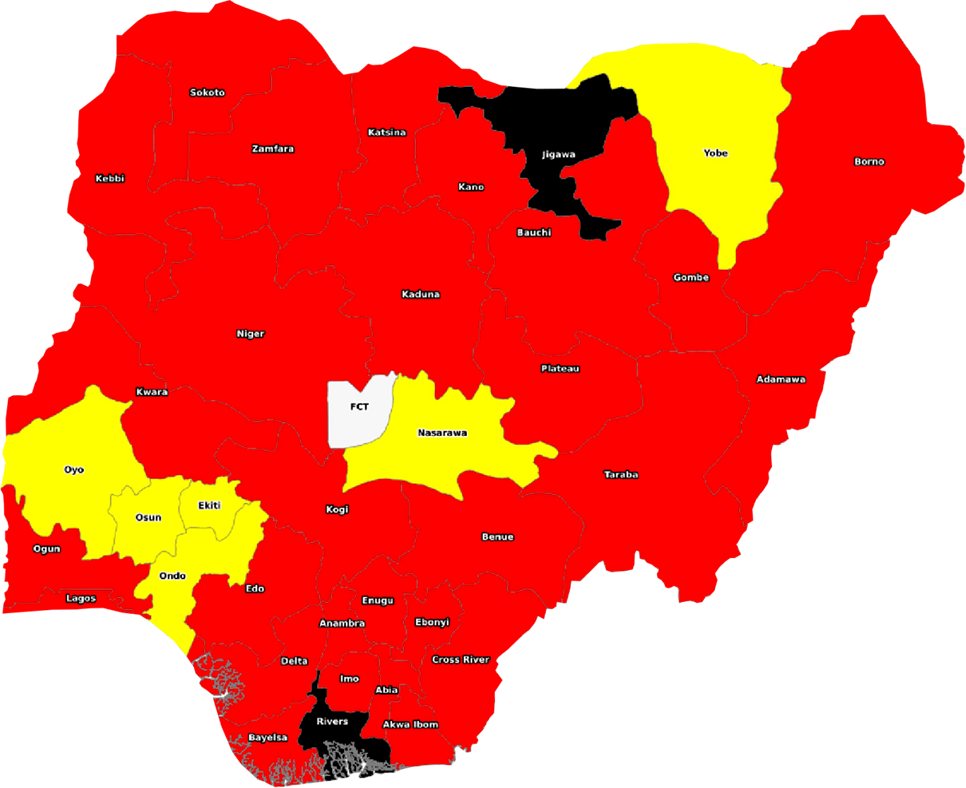
Across all 36 states assessed, not a single one reached the threshold for high democratic performance. Only six states, Oyo, Yobe, Ekiti, Nasarawa, Ondo, and Osun, recorded moderate performance. The rest remain trapped within low or weak democratic categories.
That is more than data. It reflects a country where democracy remains active yet increasingly disconnected from citizens' everyday expectations. Nigeria still votes; campaigns remain loud; elections continue to be held; political parties multiply and democratic institutions formally exist. Yet for millions of Nigerians, democracy often feels distant from governance itself.
This is the contradiction now confronting the country: Nigeria has preserved the structure of democracy while struggling to deepen its substance. Citizens continue to participate, but many no longer believe participation guarantees representation. Institutions exist, but public trust remains fragile. Elections are conducted, yet governance outcomes often fail to inspire confidence, fairness, or inclusion.
Democracy, in many instances, has become performative, visible in ceremony, but weaker in delivery. Nothing captures this failure more sharply than political inclusion.
According to the DPI report, 22 states fall with low inclusion, and 14 states are classified as weak, indicating severe exclusion. Every single state in Nigeria falls below acceptable standards for the representation of women, young people, and persons with disabilities, and it is alarming. A democracy that consistently excludes large segments of its population cannot convincingly claim to represent the people. Exclusion on this scale is not merely a governance weakness; it is a legitimacy crisis quietly unfolding in plain sight.
Young Nigerians are repeatedly told they are the future yet remain structurally sidelined from the spaces where decisions about that future are made. Women continue to face political barriers disguised as tradition, culture, or party realities. Persons with disabilities remain largely invisible within governance structures meant to serve all citizens equally.
The condition of democratic institutions raises equally serious concerns. While state assemblies, oversight bodies, and governance structures remain formally operational, the report shows that 22 states operate below moderate institutional standards, with only 14 states falling within the moderate institutional effectiveness category. Weak legislative oversight, limited transparency, constrained fiscal accountability, and poor institutional openness continue to undermine public confidence in governance. For many Nigerians, governance remains distant, inaccessible, and insufficiently accountable, and citizens increasingly feel the consequences in their everyday realities.
They feel it when public resources disappear without consequence. They feel it when budgets are inaccessible. They feel it when governance becomes an elite conversation conducted far above public reach.
Even more troubling is the shrinking condition of civic space across parts of the country. The report shows that half of Nigeria’s states operate under shrinking or repressed civic conditions, where freedoms of expression, association, and assembly face varying levels of restriction.
This matters because democracy weakens long before elections disappear. It weakens when citizens begin to fear speaking honestly, when criticism is treated as hostility, and when people slowly disengage because they no longer believe their voices matter. And perhaps that is the greatest democratic danger facing Nigeria today. Because when citizens lose confidence that democracy can improve their lives, democracy begins to lose meaning.
The significance of the KDI report lies not only in what it reveals, but in what it demands. It challenges Nigeria to move beyond celebrating democratic survival toward demanding democratic performance. From 1999 to date, Nigeria has experienced 27 years of uninterrupted civilian rule, the national conversation can no longer end with whether elections were conducted. The more urgent question is whether governance is becoming more accountable, more inclusive, more transparent, and more responsive to citizens.
Nigeria’s democracy is not performing uniformly. It is weakening unevenly across institutions, states, and dimensions of public life. The significance of the DPI 2025 Report lies in forcing the country to confront that reality honestly. Elections alone can no longer serve as the sole evidence of democratic health. The deeper test is whether institutions remain capable of earning public trust, protecting civic freedoms, and delivering governance that citizens can genuinely experience. That is the democratic question now facing Nigeria.


